 Subscribe Now and Experience Yeshua Glory!

 Read QnA
1. Defining Eschatology—The Scope of the Last Things
Eschatology is broadly divided into two interrelated areas: Individual Eschatology and General (or Cosmic) Eschatology. Both are anchored in the person and work of Jesus Christ.
A. Individual Eschatology
Individual eschatology addresses the destiny of the human soul immediately following physical death. It answers the fundamental questions regarding the fate of the believer and the non-believer at the close of their earthly lives.
<> Individual Eschatology
-
Death And The Intermediate State: The Christian affirmation is that death is not annihilation but a transition.
The Apostle Paul famously articulated the believer’s yearning to depart and "be with Christ, for that is very much better" (Philippians 1:23). Scripture indicates that upon death, the soul of the believer enters into a conscious state of blessedness in the presence of the Lord.
The most solemn fact of individual eschatology is found in the New Testament declaration that "it is appointed for men to die once, and after this comes judgment" (Hebrews 9:27). This underscores the urgency of faith, affirming that one’s eternal standing is fixed at the moment of death. -
The Resurrection of the Body: Crucially, the intermediate state is not the final state. Biblical hope culminates not in the disembodied spirit floating eternally, but in the bodily resurrection.
This doctrine is the very cornerstone of Christian faith; as Paul teaches, if the dead are not raised, "then Christ has not been raised, and if Christ has not been raised, your faith is useless" (1 Corinthians 15:16-17).
The final destiny of the redeemed involves the reuniting of the spirit with a resurrected, glorified body—a body fit for eternity and patterned after Christ’s own resurrection body (1 Corinthians 15:42-44; Philippians 3:21).
This truth elevates the physical world and affirms that God will redeem not just souls, but the entire creation, including our physical selves.
B. General Eschatology
General eschatology concerns the grand climax of world history and the final, sweeping acts of God that usher in the eternal state. It focuses on events concerning the Church and the cosmos as a whole.
<> General Eschatology
-
The Second Coming Of Christ: This is the central event of General Eschatology. The New Testament makes it abundantly clear that the return of Jesus Christ will be literal, personal, visible, and triumphant . Jesus ascended to Heaven and will return in the same manner (Acts 1:11).
The Second Coming concludes the present age and inaugurates the subsequent events of judgment and eternal renewal. It is the event toward which the Church continually looks, providing the fundamental reason for watchfulness and anticipation. -
The Millennium (The Thousand-Year Reign): Perhaps the most debated aspect of eschatology is the interpretation of the thousand-year period mentioned in the book of Revelation, chapter 20. The four major views—Amillennialism, Postmillennialism, Historical Premillennialism, and Dispensational Premillennialism—offer distinct frameworks for understanding the relationship between Christ's return and this reign.
Amillennialism views the thousand years symbolically, asserting that Christ’s reign is occurring now through the Church and in Heaven, and that His return initiates the eternal state immediately.
Postmillennialism anticipates that the Gospel will gradually triumph in the world, leading to an age of widespread peace and righteousness (the Millennium) before Christ’s physical return.
Premillennialism holds that Christ returns before the literal thousand-year reign on Earth, which is then followed by the final judgment. -
The Final Judgment: Following the culmination of the ages, Scripture teaches that all humanity—both the righteous and the unrighteous—will stand before God's judgment seat. The non-believers are judged according to their works, leading to eternal separation from God (Revelation 20:11-15).
The believers, having been justified by faith, receive rewards based on their faithfulness and works done in Christ, and are confirmed in their eternal dwelling. This doctrine assures the Christian that history is moving toward a morally meaningful conclusion where all wrongs will be made right and God’s perfect justice will be unequivocally displayed. -
The New Heavens and the New Earth: The true climax is not merely a transfer to a spiritual realm, but the recreation of the cosmos. The biblical vision is of a New Heaven and a New Earth where "righteousness dwells" (2 Peter 3:13). God does not abandon creation; He renews and perfects it.
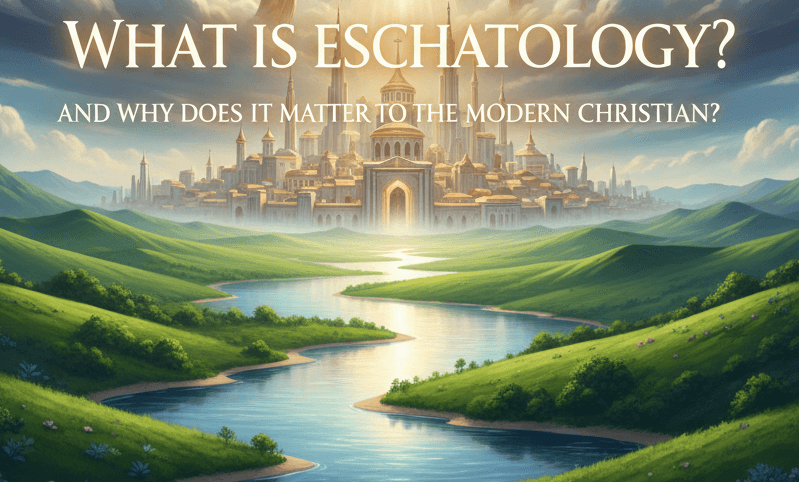
This eternal state is depicted as the arrival of the New Jerusalem, where God dwells with humanity, and where there is no more death, mourning, crying, or pain (Revelation 21:1-4). This is the great and glorious future, the permanent, perfect environment for the redeemed people of God.
2. Why Eschatology Matters to the Modern Christian
The modern world often operates under the assumption of a closed universe—a system of fixed natural laws where ultimate meaning is self-created.
For the Christian facing this pervasive secularism, a robust eschatology is not a quaint historical study; it is an existential necessity.
It is the counter-narrative to despair, the fuel for ethical action, and the defining characteristic of Christian identity.
A. Eschatology Provides Unshakeable Hope (The Anchor)
In the 21st century, hope is often provisional, tied to economic stability, medical breakthroughs, or political change. When these foundations shift, hope crumbles. Eschatology, however, grounds hope in a divine promise that transcends all earthly conditions.
The Apostle Paul articulated this well, stating, "For in hope we were saved, but hope that is seen is not hope; for who hopes for what he already sees? But if we hope for what we do not see, with perseverance we wait eagerly for it" (Romans 8:24-25).
The certainty that Christ will return and will establish a perfect, eternal Kingdom allows the believer to endure persecution, economic hardship, and injustice without falling into cynicism.
The Christian knows that every temporary suffering is light and momentary when viewed against the backdrop of eternal glory (2 Corinthians 4:17). Eschatology converts passive optimism into active, persevering endurance because the destination is guaranteed by the faithfulness of God.
It shifts the Christian’s focus from temporal security to eternal security, making the disappointments of the present age bearable because they are ultimately temporary.
This theological lens enables the believer to live with a perspective that is fundamentally contrary to the prevailing spirit of anxiety and short-sightedness.
B. Eschatology Demands Ethical Living (The Imperative For Holiness)
The expectation of Christ’s return and the reality of the Final Judgment serve as the most potent catalysts for sanctification and ethical conduct. If a person believes their works will be scrutinized before a holy God, that belief must inevitably influence their daily decisions.
The Apostle John connected the hope of Christ’s appearance directly to the pursuit of moral purity: "Beloved, now we are children of God, and it has not appeared as yet what we will be.
We know that when He appears, we will be like Him, because we will see Him just as He is. And everyone who has this hope fixed on Him purifies himself, just as He is pure" (1 John 3:2-3).
The coming of the Lord is not merely a spiritual concept; it is an event demanding preparation. This preparation is not accomplished by building physical bunkers, but by building moral character. The doctrine of the New Earth, where righteousness dwells, means that the Christian must begin practicing that righteousness now.
Eschatology refutes the notion of "cheap grace" and calls the believer to diligence, accountability, and disciplined living. It demands integrity in business, purity in relationships, and compassion toward the vulnerable, all because the Judge is standing at the door (James 5:9).
It is impossible to genuinely embrace the promise of a holy future without striving for holiness in the present.
C. Eschatology Fuels Mission And Evangelism (The Driving Force)
The Great Commission is inextricably linked to the end-times framework.
The command to "make disciples of all nations" (Matthew 28:19) is a direct response to the ultimate authority given to Christ both in Heaven and on Earth—an authority He will fully exercise at His return.
The Church does not preach a system of self-improvement; it preaches a saving event (the past work of Christ) and a coming event (the future triumph of Christ). Without eschatology, evangelism lacks its ultimate urgency.
The warning of the Final Judgment provides the solemn motivation for sharing the Gospel with love and clarity, understanding that the eternal destiny of souls is at stake.
Furthermore, the vision of the New Jerusalem—a community composed of people "from every tribe and language and people and nation" (Revelation 5:9)—provides the universal scope of the Church's mission.
The hope is not merely for individual salvation, but for the gathering of a global family. The modern Christian’s mission is therefore to embody and announce the coming reign of Christ until He returns.
D. Eschatology Undergirds Social Justice (The Demand for Equity)
The study of last things is frequently misconstrued as purely spiritual, neglecting its profound implications for the material world.
However, the promise of the New Heavens and New Earth, where God definitively wipes away every tear and eliminates all injustice, compels the modern Christian to engage with issues of social justice today.
If God promises a future characterized by perfect peace, equity, and the complete absence of systemic oppression, then the Church is mandated to be a foretaste of that future in the present.
The cry of the prophets against corruption, poverty, and exploitation was an eschatological cry—a demand for life on Earth to reflect God's coming reign.
Therefore, the modern Christian cannot ethically compartmentalize their faith. The hope for the New Earth should motivate the fight against human trafficking, the pursuit of racial reconciliation, the care for the environment (which God will eventually redeem), and the advocacy for the poor.
Eschatology transforms social action from mere humanistic benevolence into a prophetic act, declaring that the present structures of injustice are temporary and ultimately doomed by the righteous coming of the King.
3. Navigating Modern Eschatological Challenges
The contemporary Church must confront several challenges that complicate the wholesome study of eschatology.
A. The Problem Of Sensationalism And Date-Setting
A historical failing within segments of Christianity has been the obsession with precise prophetic timelines and date-setting. This hyper-focus often leads to three negative outcomes: disappointment when dates fail, distraction from the core Gospel message, and division within the body of Christ.
Jesus specifically warned against this kind of speculation: "It is not for you to know times or epochs which the Father has fixed by His own authority" (Acts 1:7).
The value of eschatology lies not in knowing the when, but in understanding the what and the why—the fact of Christ’s return and the purpose it serves.
The modern Christian must approach prophecy with humility, prioritizing ethical readiness over speculative curiosity.
B. The Tension Of The "Already And Not Yet"
Perhaps the most sophisticated challenge is the accurate theological balancing of the "already" and the "not yet." The New Testament affirms that in Christ’s first coming, death was defeated, the Holy Spirit was given, and the Kingdom of God has already been inaugurated (Colossians 1:13; Luke 17:21). The victory has been secured.
However, we are still waiting for Christ’s Second Coming, the resurrection, and the removal of all sin and suffering; the Kingdom has not yet fully arrived (Romans 8:23).
The modern Christian lives in this pregnant tension. The "already" empowers the believer with the Holy Spirit and enables ethical living now.
The "not yet" keeps the believer humble, dependent, and yearning for final perfection. Mismanaging this tension leads either to: Over-realized Eschatology: Believing the Kingdom is fully here, leading to triumphalism and disappointment when the world remains broken.
Under-realized Eschatology: Believing the Kingdom is entirely in the future, leading to spiritual passivity and neglecting present-day responsibilities.
Sound eschatology teaches us to labor diligently in the present as servants of a King whose reign has begun, even as we look eagerly for His glorious return to consummate that reign.
C. The Challenge Of Delay And Skepticism
Two thousand years have passed since the promise of Christ’s return was first given. This delay inevitably breeds skepticism, both inside and outside the Church.
Peter addressed this ancient problem directly: "Know this first of all, that in the last days mockers will come with their mocking, following after their own lusts, and saying, 'Where is the promise of His coming? For ever since the fathers fell asleep, all things continue just as they were from the beginning of creation'" (2 Peter 3:3-4).
The biblical answer to the perceived delay is not one of confusion, but of grace. Peter explains that the Lord is "not slow about His promise, as some count slowness, but is patient toward you, not wishing for any to perish but for all to come to repentance" (2 Peter 3:9).
The delay is an extension of God’s mercy, providing more time for evangelism and reconciliation. For the modern Christian, the long wait is a call to heightened patience, evangelistic activity, and faithfulness, rather than a reason for doubt.
4. The Enduring Legacy of the End
Eschatology, ultimately, is the doctrine of purpose. It defines the beginning by pointing to the end.
The reason for creation, the necessity of the Fall, the agony of the Cross, and the power of the Resurrection—all are given their ultimate meaning by the promise of the New Creation.
The study of last things is not simply a mental exercise in interpreting ancient prophecies; it is a spiritual discipline that recalibrates the soul. It teaches the Christian that the ultimate reality is not found in the ephemeral markets of Earth, the shifting sands of political power, or the transient comforts of worldly success.
Ultimate reality is the perfect, unending reign of Jesus Christ on a restored Earth.
Therefore, for the believer navigating a complex, demanding, and often discouraging modern existence, eschatology serves as the ultimate spiritual GPS.
It reminds them of who they are (citizens of Heaven), where they are going (the New Jerusalem), and what they should be doing in the interim (laboring faithfully and living purely in anticipation of the King).
It transforms the current age from a meaningless cycle of events into a divine narrative moving irrevocably toward its glorious, predetermined conclusion.
The Final Triumph
The quest to understand "What is Eschatology and Why Does it Matter to the Modern Christian?" leads us inevitably to the realization that this discipline is the glorious culmination of all Christian theology.
It is the destination that defines the journey of faith. We conclude by observing that a Christian without a robust eschatology is a pilgrim who has forgotten the map, confusing temporary rest stops for the eternal homeland.
The true significance of eschatology rests not in the specifics of raptures or tribulation periods, but in the overwhelming assurance that God wins.
His purpose cannot be thwarted by human malice, historical chaos, or even the power of death itself. The ultimate fate of the Church is not to fade away, but to be perfected in the presence of its King, inheriting a cosmos free from sin and suffering.
This profound reality—the definitive triumph of God’s loving, righteous, and sovereign will—is the only stable ground upon which the modern believer can build a life of courageous hope, radical ethical commitment, and unwavering missional zeal.
Let us, therefore, embrace the doctrine of last things not with fear or sensationalism, but with the sober, confident joy of a people who know the ending of the story.
May the anticipation of the New Heavens and the New Earth transform the way we labor, the way we suffer, and the way we love today, until the moment the skies part and our ultimate hope—Jesus Christ—returns in glory.
The study of the end demands a transformation of the beginning, and for this reason alone, eschatology matters profoundly to every Christian.
Give you life to God today and accept Jesus Christ as your Lord and Saviour. Pray this simple repentance prayer now and you shall be saved!
Do not wait for tomorrow do it right now while you still have the opportunity!
You can share this link:
http://www.yeshuaglory.com/what-is-eschatology-and-its-relevance-to-modern-christianity.php
,
with as many people as you would like, because we want this revelation to reach many people to be saved.
Be watchful and prayerful, the Lord Jesus is coming already!

Did you find this article valuable?
If you're being blessed and enjoying the content, consider contributing to MYG today. Any amount is appreciated!
 Contribute

 Subscribe













 info@yeshuaglory.com
 Overcomer
 NEDBANK
 Paypal Handle: