 Subscribe Now and Experience Yeshua Glory!


 Read QnA
1. The Biblical Promises Of Israel's Restoration

Before we can evaluate whether 1948 was prophetic fulfillment, we need to understand what the Old Testament actually promised about Israel's future. The Hebrew Scriptures are filled with passages that speak about a future restoration of the Jewish people to their land after a period of exile and judgment.
Ezekiel 37 contains one of the most vivid pictures. The prophet sees a valley of dry bones and watches as God commands the bones to come together, receives flesh, and comes to life. God then interprets the vision: "Son of man, these bones are the people of Israel.
11. Then he said unto me, Son of man, these bones are the whole house of Israel: behold, they say, Our bones are dried, and our hope is lost: we are cut off for our parts.
12. Therefore prophesy and say unto them, Thus saith the Lord GOD; Behold, O my people, I will open your graves, and cause you to come up out of your graves, and bring you into the land of Israel.
Ezekiel 37:11-12
This prophecy was given during the Babylonian exile, and it had an initial fulfillment when Jews returned under Ezra and Nehemiah. But many scholars believe it also points to a future, more complete restoration.
Ezekiel 37:21-22 describes God gathering His people "from all around" and making them "one nation in the land, on the mountains of Israel."
21. And say unto them, Thus saith the Lord GOD; Behold, I will take the children of Israel from among the heathen, whither they be gone, and will gather them on every side, and bring them into their own land:
22. And I will make them one nation in the land upon the mountains of Israel; and one king shall be king to them all: and they shall be no more two nations, neither shall they be divided into two kingdoms any more at all:
Ezekiel 37:21-22
Isaiah 11:11-12 speaks of a second gathering:
11. And it shall come to pass in that day, that the Lord shall set his hand again the second time to recover the remnant of his people, which shall be left, from Assyria, and from Egypt, and from Pathros, and from Cush, and from Elam, and from Shinar, and from Hamath, and from the islands of the sea.
12. And he shall set up an ensign for the nations, and shall assemble the outcasts of Israel, and gather together the dispersed of Judah from the four corners of the earth.
Isaiah 11:11-12
Jeremiah 31:10 declares;
10. Hear the word of the LORD, O ye nations, and declare it in the isles afar off, and say, He that scattered Israel will gather him, and keep him, as a shepherd doth his flock.
Jeremiah 31:10
The chapter goes on to describe a new covenant God will make with the house of Israel and Judah, written on their hearts rather than on tablets of stone.
Amos 9:14-15 provides a striking promise:
14. And I will bring again the captivity of my people of Israel, and they shall build the waste cities, and inhabit them; and they shall plant vineyards, and drink the wine thereof; they shall also make gardens, and eat the fruit of them.
15. And I will plant them upon their land, and they shall no more be pulled up out of their land which I have given them, saith the LORD thy God.
Amos 9:14-15
Zechariah 8:7-8 adds;
7. Thus saith the LORD of hosts; Behold, I will save my people from the east country, and from the west country;
8. And I will bring them, and they shall dwell in the midst of Jerusalem: and they shall be my people, and I will be their God, in truth and in righteousness.
Zechariah 8:7-8
These are just a sampling of many passages that predict Israel's return.
The consistent themes are: exile as judgment for sin, eventual restoration to the land, gathering from worldwide dispersion, and ultimately spiritual renewal alongside physical return.
The critical question is whether these prophecies were completely fulfilled in the return from Babylon, or whether they point to something more—a final, comprehensive restoration that includes both physical return and spiritual renewal.
Most prophecy scholars believe the language suggests something beyond the limited return under Ezra and Nehemiah, pointing instead to a greater fulfillment in the last days.
2. The Fig Tree Prophecy: What Did Jesus Mean?
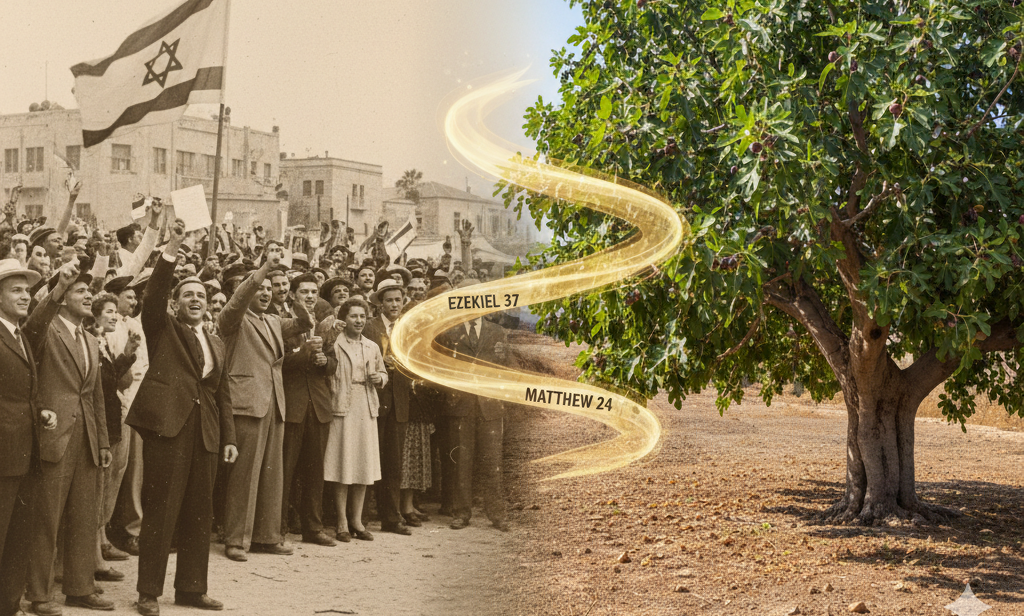
The passage most commonly cited in connection with Israel's 1948 restoration is Matthew 24:32-35, where Jesus says:
34. Verily I say unto you, This generation shall not pass, till all these things be fulfilled.
35. Heaven and earth shall pass away, but my words shall not pass away.
Matthew 24:32-35
The interpretation that the fig tree represents Israel and its budding represents the nation's restoration in 1948 has become popular in certain prophecy circles. Proponents point out that the fig tree is used elsewhere in Scripture as a symbol for Israel.
Jesus cursed a fig tree in Matthew 21, which some see as symbolic of judgment on Israel.
Therefore, they argue, the fig tree budding represents Israel coming back to life after centuries of being "cursed" through exile and dispersion.
If this interpretation is correct, it has staggering implications. Jesus says "this generation" will not pass away until all these things happen.
If the fig tree budding refers to 1948, and a biblical generation is typically considered 70-80 years (based on Psalm 90:10), then all the events Jesus described—including His return—should occur within a lifetime of 1948. This would place us very close to or even past the window for Christ's return.
However, we must be careful here. Is this interpretation actually what Jesus meant, or is it reading something into the text that is not there?..
When we examine the passage in context, Jesus has just finished describing signs of the end: false messiahs, wars, famines, earthquakes, persecution, the abomination of desolation, and cosmic disturbances. Then He says, essentially, "Just as you know summer is near when a fig tree buds, you will know the time is near when you see all these things."
Notice what Jesus is actually saying. He is using the fig tree as an illustration of recognizing seasons. Everyone in that culture knew that when a fig tree starts budding, summer is coming soon. It is a natural, observable progression.
Jesus is saying the same will be true of the signs He just described. When you see those signs, you will know the time is near. The critical question is whether Jesus intended the fig tree itself to represent Israel, or whether He was simply using it as a common illustration. Luke 21:29-30 adds an important detail:
29. And he spake to them a parable; Behold the fig tree, and all the trees;
30. When they now shoot forth, ye see and know of your own selves that summer is now nigh at hand.
Luke 21:29-30
Notice that Luke mentions "all the trees," not just the fig tree. This suggests Jesus was using trees in general as an illustration of recognizing seasonal signs, not specifically encoding Israel as the fig tree. If the fig tree specifically represented Israel, why would Luke add "and all the trees"?
Furthermore, the phrase "this generation" in verse 34 is highly debated. Some believe it refers to the generation alive when these signs begin to appear. Others believe it refers to the Jewish people as a whole, who will not disappear before Christ returns.
...Still others believe it referred to the generation alive when Jesus spoke, and they saw at least partial fulfillment in the destruction of Jerusalem in 70 AD.
The honest truth is that connecting the fig tree specifically to Israel's 1948 restoration requires reading that meaning into the text. It is not explicitly stated.
That does not mean the interpretation is necessarily wrong, but it does mean we should hold it more loosely than interpretations that come directly from the text itself.
3. The Historical Reality Of 1948

Regardless of how we interpret specific prophecies, we cannot deny the historical significance of what happened in 1948.
The rebirth of Israel after nearly two millennia is without precedent in human history. Consider what had to happen for Israel to exist again.
1. Distinct Identity
Jews had to maintain their distinct identity throughout 1,900 years of dispersion.
They had to preserve their language, their culture, their religion, and their identity as a people despite living as minorities in hostile nations. They endured expulsions, pogroms, ghettos, and eventually the Holocaust; yet they survived as Jews.
2. Political Alignment
The political circumstances had to align. The Zionist movement, beginning in the late 1800s, advocated for a Jewish homeland. The Balfour Declaration of 1917 expressed British support for a Jewish national home in Palestine. The horrors of the Holocaust created international sympathy. The United Nations voted to partition Palestine into Jewish and Arab states. All of these unlikely pieces had to fall into place.
3. Land Availability
The land had to be available and habitable. Mark Twain visited Palestine in the 1860s and described it as desolate and largely abandoned. But by the early 1900s, Jewish pioneers were draining swamps, planting forests, and making the desert bloom. What had been barren wasteland was transformed into productive farmland.
4. Language Roots
The language had to be revived. Hebrew had been a dead language for everyday use for centuries, preserved only for religious purposes. But through the efforts of Eliezer Ben-Yehuda and others, Hebrew was revived as a living, spoken language. Today, millions speak the same language Isaiah and Jeremiah spoke. This alone is miraculous.
5. Resisting Opposition
Israel had to survive immediate attempts at its destruction. The moment independence was declared, five Arab armies invaded with the stated goal of driving the Jews into the sea. Israel was outnumbered and outgunned. By any military calculation, it should have been destroyed. Yet not only did Israel survive, it gained more territory than the UN partition plan had allocated.
And Israel has continued to survive despite multiple wars, constant terrorism, international opposition, and threats to its existence from surrounding nations. The tiny nation—smaller than New Jersey—has prevailed against all odds.
From a purely historical perspective, Israel's existence is remarkable. From a biblical perspective, many see it as impossible to explain apart from divine intervention.
How do you account for a people maintaining their identity for two millennia and then returning to their ancestral homeland, reviving their ancient language, and establishing a thriving nation? Coincidence? Historical accident? Or providence?
4. Does Israel's Restoration Have Prophetic Significance?

Even if we conclude that the fig tree prophecy does not specifically refer to 1948, that does not settle the question of whether Israel's restoration has prophetic significance...
Many theologians and prophecy scholars believe it does, for several compelling reasons.
1. Divine Intervention
The sheer improbability of Israel's existence suggests divine orchestration. As we have noted, no other ancient people have done what the Jews have done. The preservation of Jewish identity and the restoration of their nation defies natural explanation.
If God promised He would bring His people back and never again uproot them (Amos 9:15), then 1948 looks like that promise being fulfilled.
2. Multiple Prophecies Of Restoration From The Ends Of The World
Multiple prophecies predicted not just return from Babylon, but return from worldwide dispersion.
The Babylonian exile involved only a portion of Jews and only lasted 70 years. But the dispersion after 70 AD scattered Jews to literally every nation on earth for 1,900 years.
The ingathering that began in the late 1800s and accelerated after 1948 brought Jews from over 100 countries back to Israel. This matches the prophetic descriptions of gathering "from the four corners of the earth" (Isaiah 11:12).
3. Prophecy fulfillment
Other prophecies are being fulfilled in connection with Israel's return. Ezekiel 36:8-11 predicted the land would become fruitful again: "But you, mountains of Israel, will produce branches and fruit for my people Israel, for they will soon come home...
I will make you more prosperous than before." This has literally happened. Israel has transformed desert into farmland, developed world-class agriculture, and made the land productive in ways it had not been for centuries.
4. Jerusalem In End Time Prophecy
The focus on Jerusalem in end-times prophecy makes more sense with Israel as a nation. Zechariah 12:2-3 says, "I am going to make Jerusalem a cup that sends all the surrounding peoples reeling...
On that day, when all the nations of the earth are gathered against her, I will make Jerusalem an immovable rock for all the nations."
For Jerusalem to be a source of international conflict, as prophesied, it needed to be under Jewish control again. This happened in 1967 when Israel recaptured the Old City.
5. Israel Will Be Saved
Fifth, Paul's statement in Romans 11 suggests a future for ethnic Israel in God's plan. He writes, "Did God reject his people? By no means!... Did they stumble so as to fall beyond recovery? Not at all!...
If their transgression means riches for the world, and their loss means riches for the Gentiles, how much greater riches will their full inclusion bring!" (Romans 11:1, 11-12). Paul concludes, "And in this way all Israel will be saved" (Romans 11:26).
This suggests a future salvation of ethnic Israel, which would seem to require Israel existing as a nation. These arguments do not constitute proof, but they provide strong reasons to see prophetic significance in Israel's restoration.
5. Alternative Perspectives
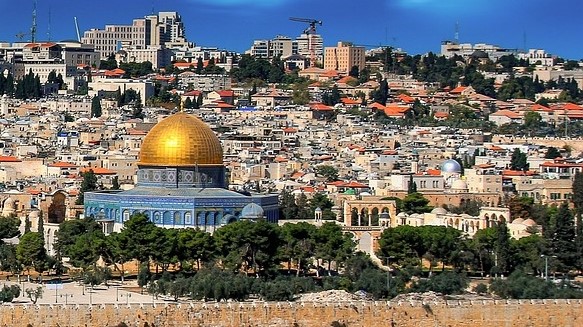
Not all Christians agree that Israel's restoration in 1948 has prophetic significance. Some hold replacement theology (also called supersessionism), which teaches that the church has replaced Israel in God's plan and that Old Testament promises to Israel are now fulfilled spiritually in the church.
From this perspective, modern political Israel has no special prophetic significance. Others acknowledge that God has preserved the Jewish people but do not see the secular state of Israel as necessarily fulfilling biblical prophecy.
They note that the current state of Israel was established through political and military means, not through repentance and spiritual revival. Most Israelis are secular, not followers of the Messiah. How can this be prophetic fulfillment when the prophets consistently linked physical restoration with spiritual renewal?
These critics have a point. Ezekiel 36, after describing physical restoration, says;
26. A new heart also will I give you, and a new spirit will I put within you: and I will take away the stony heart out of your flesh, and I will give you an heart of flesh.
27. And I will put my spirit within you, and cause you to walk in my statutes, and ye shall keep my judgments, and do them.
Ezekiel 36:26-27
This spiritual component is largely absent in modern Israel. Some suggest that what we are seeing is preparatory—God bringing His people back to the land physically before bringing about spiritual restoration. They point out that Ezekiel 37 shows the bones coming together and receiving flesh before the breath (Spirit) enters them.
The physical restoration precedes the spiritual awakening. Others maintain that we should focus on the Great Commission and not get distracted by Middle Eastern politics. They argue that excessive focus on Israel can lead to neglecting evangelism, supporting unjust policies, or misreading current events through a prophetic lens that distorts reality.
These perspectives deserve consideration. We must be careful not to let our theology dictate our interpretation of current events in ways that blind us to injustice or complexity.
The Israeli-Palestinian conflict is real, and real people suffer. Supporting Israel prophetically does not mean ignoring legitimate grievances or endorsing every policy.
6. What Should Christians Believe About Israel Today?

So where does this leave us? How should Christians think about modern Israel?
<> Here Are Some Principles Grounded In Scripture:
- Recognize God's Faithfulness: Whether or not every specific prophecy is being fulfilled right now, God's preservation of the Jewish people demonstrates His faithfulness. He made promises to Abraham, Isaac, and Jacob. He has kept those promises through millennia. This should strengthen our confidence that He keeps His promises to us as well.
- A Story Of Everlasting And Unfailing Love Of God: God's relentless pursuit of a relationship with you (God loves us with an everlasting love and He is our Father, and He really wants no soul to perif!).
- Pray for Israel: Scripture tells us to "pray for the peace of Jerusalem" (Psalm 122:6). This does not require us to support every government policy, but it does mean genuinely desiring blessing and peace for Israel and the Jewish people.
- Reject Antisemitism: Christians have a shameful history of antisemitism, from medieval pogroms to complicity in the Holocaust. This is absolutely incompatible with biblical Christianity. We must actively oppose antisemitism in all its forms.
- Avoid Date-Setting: Even if we believe Israel's restoration has prophetic significance, we must not use it to calculate when Jesus will return. Many have tried this and all have been wrong. Jesus said no one knows the day or hour (Matthew 24:36).
- Maintain Balance: We can recognize prophetic significance without turning Israel into an idol or ignoring injustice. We can support Jewish people without demonizing Palestinians. We can watch events with interest without becoming obsessed.
- Focus on the Gospel: Our primary calling is to make disciples of all nations—including both Jews and Arabs. The gospel is for everyone. While we watch for Christ's return, we must faithfully do the work He gave us.
- Recognize Complexity: The Israeli-Palestinian conflict is complex, with valid concerns and suffering on both sides. Christians should avoid simplistic narratives that paint everything in black and white.
7. The Greater Story
Here is what we must not miss in all the debate about prophetic fulfillment and political events: the story is ultimately about Jesus, not about Israel. Israel matters because of what God is doing through Israel, not because Israel is an end in itself.
God made promises to Abraham that through his seed all nations would be blessed (Genesis 12:3). That promise finds its ultimate fulfillment in Jesus Christ, the Jewish Messiah who brings salvation to the whole world. The story of Israel is really the story of how God prepared the way for the Messiah and how He will ultimately bring both Jews and Gentiles into one body through faith in Christ.
Romans 11 makes this clear. Paul describes wild olive branches (Gentiles) being grafted into the cultivated olive tree (Israel). He warns Gentile believers not to be arrogant but to remember they have been brought into something that began with Israel.
Then he speaks of natural branches (ethnic Jews) being grafted back in when they come to faith. The end result is one tree, one people of God, united in Christ. This is why the question of whether 1948 fulfilled specific prophecies, while interesting, is not the main point.
The main point is that God is faithful, His purposes are unfolding, and His ultimate goal is the redemption of all who trust in His Son from every tribe, tongue, and nation, hallelujah!
The restoration of Israel should point us to the greater restoration that is coming—when Christ returns, establishes His kingdom, and makes all things new. It should remind us that God keeps His promises...
...It should increase our confidence that just as He preserved Israel through impossible circumstances, He will preserve us and complete the work He started in us.
Was Israel's Restoration In 1948 The Fulfillment Of The Fig Tree Prophecy?
Now it is time to deal with the elephant in the room: so was Israel's restoration in 1948 the fulfillment of the fig tree prophecy?
...The honest answer is...that we cannot be completely certain! The connection requires interpretive assumptions that may or may not be correct....
Reasonable Christians disagree about whether the fig tree specifically represents Israel and whether Jesus intended His words to point to 1948.
But here is what we can say with confidence: Israel's rebirth after 1,900 years is historically unprecedented and remarkable. The Jewish people's survival and return to their ancient homeland defies natural explanation. Multiple biblical prophecies predicted exactly this kind of restoration from worldwide dispersion.
The timing, the circumstances, and the ongoing survival of Israel in the face of constant opposition suggest something more than coincidence. Whether or not 1948 marks the specific moment of prophetic fulfillment, it certainly appears to be prophetically significant. At minimum, it demonstrates God's faithfulness to His covenant people.
At maximum, it represents a major step in the unfolding of end-times prophecy. Most likely, the truth lies somewhere in between—1948 was indeed significant, but perhaps not the complete fulfillment of all that is prophesied about Israel's restoration. What matters most is not that we can definitively check off prophecies as fulfilled, but that we recognize God is at work in human history.
He has not forgotten His promises—He has not abandoned His people—neither Jewish people nor those who have been grafted in through faith in the Messiah!
He is orchestrating events according to His purposes, moving history toward the day when every knee will bow and every tongue confess that Jesus Christ is Lord.
...So we watch; remain alert; study Scripture carefully and compare it honestly with what we see unfolding; hold our interpretations humbly, recognizing we might be wrong about details; avoid setting dates or making predictions that go beyond what Scripture clearly teaches; and above all, we keep our focus where it belongs: on Jesus Christ, the author and perfecter of our faith, who is coming again to establish His kingdom in fullness!
Israel's story is not finished. The Jewish people have returned to the land, but they have not yet returned to their Messiah. That day is still coming. Zechariah 12:10 predicts, "They will look on me, the one they have pierced, and they will mourn for him as one mourns for an only child."
Romans 11:26 promises, "And in this way all Israel will be saved." The physical restoration may be substantially complete, but the spiritual restoration is still ahead.
When that day comes—when Jewish eyes are opened to recognize Yeshua as their Messiah, when the veil is lifted, when those who were temporarily hardened embrace the one they crucified and discover He died for them—the world will witness something glorious.
And perhaps then we will look back and see clearly how God was preparing the way all along, beginning with a nation reborn in a single day in 1948.
Until then, we watch, we pray, we proclaim the gospel to all people, and we wait with eager expectation for the return of the King. Whether the fig tree has budded or not, summer is coming... And with it, the Son of Righteousness will arise with healing in His wings, and He will appear as we wait patiently for Him, in the Name Of Jesus Christ, Amen and Amen!
...Let us be ready and prepared, for He is standing at the door ready to sound the trumpet, hallelujah!
Give you life to God today and accept Jesus Christ as your Lord and Saviour. Pray this simple repentance prayer now and you shall be saved!
Do not wait for tomorrow do it right now while you still have the opportunity!
You can share this link:
http://www.yeshuaglory.com/is-israel-restoration-1948-fig-tree-prophecy-fulfilled.php
,
with as many people as you would like, because we want this revelation to reach many people to be saved.
Be watchful and prayerful, the Lord Jesus is coming already!

Did you find this article valuable?
If you're being blessed and enjoying the content, consider contributing to MYG today. Any amount is appreciated!
 Contribute

 Subscribe














 info@yeshuaglory.com
 Overcomer
 NEDBANK
 Paypal Handle: